The basalt columns at Reynisfjara, and why they came out hexagonal
What the Gardar basalt columns at Reynisfjara actually are: how cooling lava fractures into hexagons, the giants steps photo spot, climbing safety, and how they compare to other famous columns.
 By Björn Einarsson, Iceland South Coast tour guide and local specialist
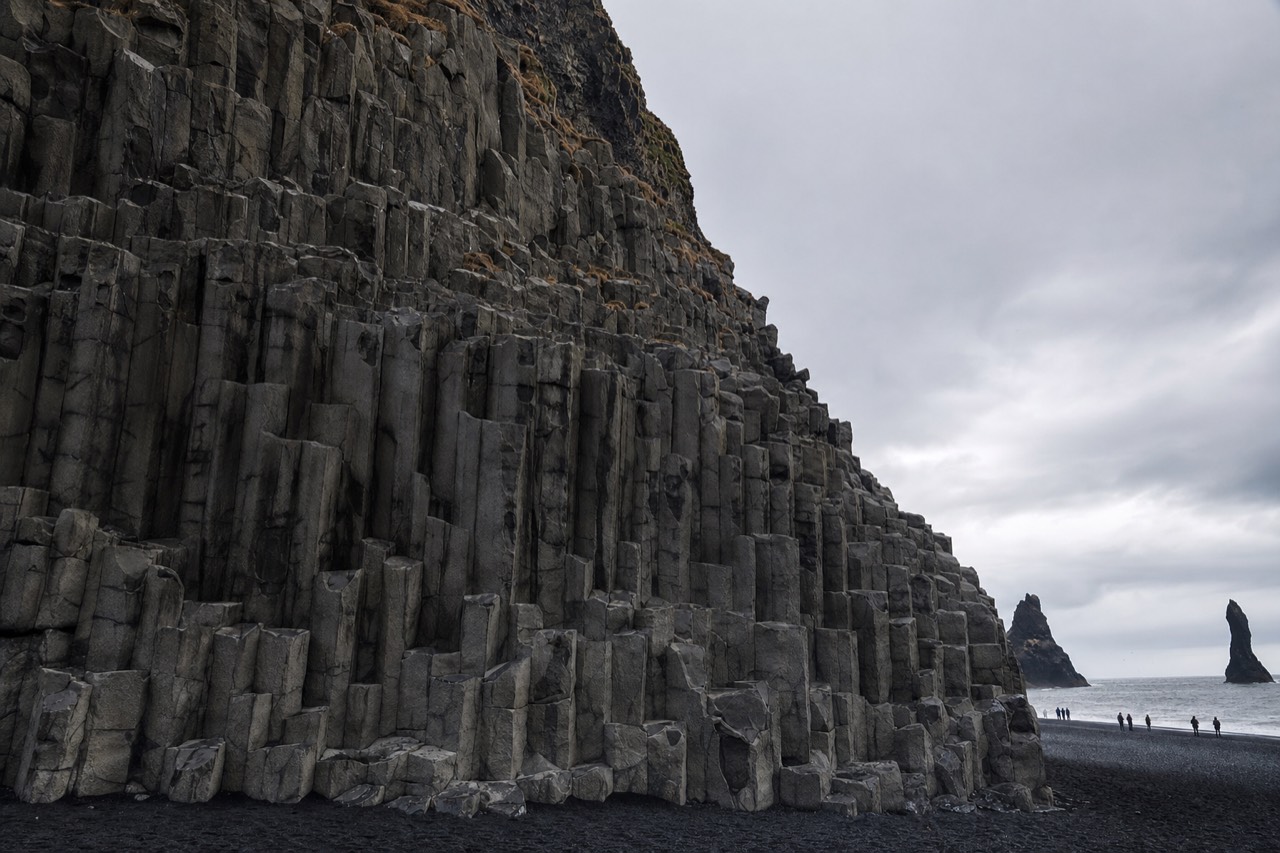
People walk straight past the sea stacks to get to the wall. The columns at the western end of Reynisfjara, called Gardar, are the single most photographed thing on the beach, and every visitor has the same first reaction: someone built this. Neat black pillars stacked in tight rows, flat tops making a natural staircase, the whole face too regular to be an accident of rock.
It is an accident of rock. A very specific one.
How does lava turn into hexagonal columns?
Cooling basalt contracts and cracks, and hexagons are the shape that relieves the most stress for the least crack, so the fractures drive downward into six-sided pillars.
The columns are basalt, cooled from a lava flow that once spread across this part of the South Coast. The trick is in how it cooled. When a thick sheet of molten basalt loses heat, it contracts, and contracting rock has to crack. The cracks start at the cooling surface and work inward, and as they propagate they tend to settle into the shape that relieves the most stress for the least crack length.
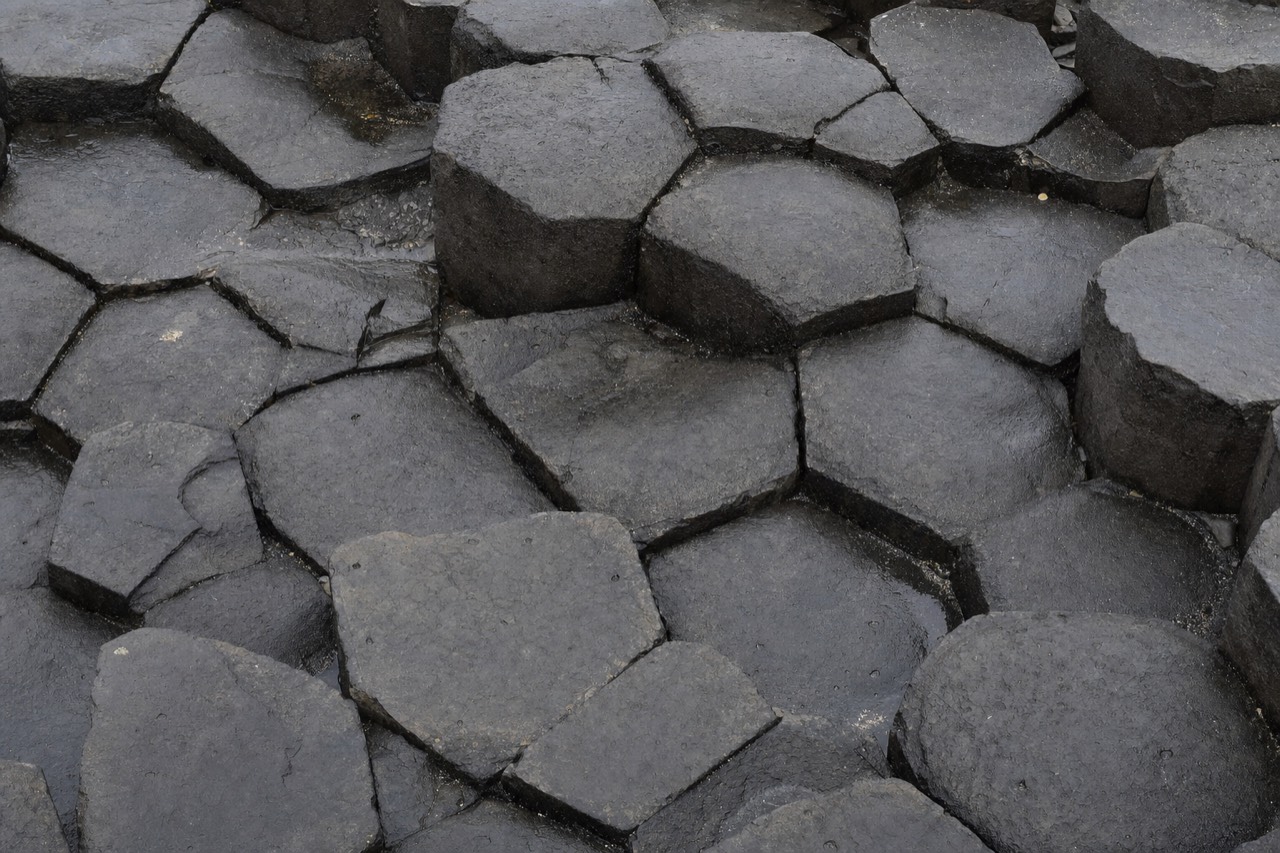
That shape is a hexagon. Not always a perfect one, and you will spot five- and seven-sided columns mixed in at Reynisfjara if you look, but the system trends toward six because six-sided cells tile a surface efficiently. The cracks then drive down through the flow as it keeps cooling, extruding those hexagonal outlines into long vertical columns. What you are looking at is a map of how heat left the ground, frozen in stone.
The flat "steps" are where columns snapped across, roughly perpendicular to their length. That is why the whole formation reads like a giant's staircase: you are seeing the tops of broken columns at different heights.
Where is the giant's steps photo spot?
It is the low tier of broken column tops at the western end of the wall, where you climb a few steps and the black basalt rises straight behind you.
The lower steps are where everyone climbs for the classic shot, one person perched a few tiers up with the black wall rising behind them. It is a genuinely good frame because the geometry does the work. Straight lines, hard shadows, that impossible regularity.
A few honest notes from watching hundreds of people do it. The stone is often wet and the sea spray keeps it slick, so the low steps are more slippery than they look. People queue, so patience gets you a cleaner background than shoving does. And the temptation is always to climb higher than is sensible for a better angle, which is where the day goes wrong.
How high is it safe to climb the columns?
Only the first two or three low steps on dry footing; higher up you are on wet, uneven basalt with a drop and no easy way down.
Scrambling up the first two or three steps is normal and, in dry conditions, fine. Higher than that and you are on wet, uneven basalt with a drop, and I have watched more than one person get stuck up a column they climbed easily and could not climb down. There is no barrier and no one is going to stop you. That is the Icelandic approach to nature: it assumes you will use judgement.
Use it. Low steps, dry footing, face the rock on the way down, and do not let a photo talk you higher than your legs can reverse.
How do Reynisfjara's columns compare to other famous ones?
The physics is identical to the Giant's Causeway, Svartifoss and Fingal's Cave, but Reynisfjara stacks a wall, a cave, offshore stacks and a black beach into one short walk.
Columnar basalt shows up in a handful of famous places, and travellers often ask how Reynisfjara stacks up. The physics is the same everywhere; the setting and scale differ.
| Site | Where | What sets it apart |
|---|---|---|
| Reynisfjara (Gardar) | South Coast, Iceland | Columns meet a black beach, sea cave and sea stacks in one spot; you can walk right up and touch them |
| Giant's Causeway | Northern Ireland | Around 40,000 columns forming a causeway into the sea; the most famous columnar basalt on earth |
| Svartifoss | Skaftafell, Iceland | A waterfall framed by dark columns; the columns hang overhead rather than standing as a wall |
| Fingal's Cave | Staffa, Scotland | Columns forming the walls of a sea cave, reached by boat, known for its acoustics |
| Reynisdrangar stacks | Off Reynisfjara | The same basalt eroded into offshore towers rather than a standing face |
Reynisfjara's advantage is not the columns alone. It is that you get the wall, the cave behind it, the stacks offshore and the beach all in one short walk, no boat and no hike. Svartifoss and the Causeway each do one thing beautifully. Reynisfjara does four in thirty minutes.
How can you see the columns yourself?
Self-drive the 180 km from Reykjavik in summer, or take the guided South Coast coach in the darker months so someone else handles the road.
Reynisfjara sits about 180 km east of Reykjavik near Vik, roughly two and a half hours on Route 1. Plenty of people self-drive it, and in summer that is a fine plan. If you are visiting in the darker months or simply do not want to manage the road, the [guided South Coast day trip from Reykjavik](https://www.getyourguide.com/reykjavik-l30/southern-iceland-tour-t67018/?partner_id=MME1WGW&utm_medium=online_publisher) drops you at the beach with time to reach the columns and the cave, and rolls in Skogafoss, Seljalandsfoss and a glacier viewpoint on the same day. It is a coach tour with food and hotel pickup included, rated 4.8 across 12,188 GetYourGuide reviews.
Stand at the base of the Gardar wall and put your hand flat on one of the hexagons. The rock is cold and the edges are cleaner than anything you would expect nature to draw freehand. That is cooling and cracking, millions of years of it, and it is one of the few places you can read that process with your own eyes.
What is the short version?
The Gardar columns are cooled basalt that cracked into rough hexagons and extruded into pillars, with the flat "steps" being broken column tops.
The Gardar columns at Reynisfjara are cooled basalt that fractured into rough hexagons as it contracted, then extruded downward into vertical pillars. The flat "giant's steps" are broken column tops. Climb only the low steps, keep to dry footing, and remember the same rock forms the Causeway, Svartifoss and Fingal's Cave elsewhere. Reynisfjara's edge is having all of it in one place.