Shooting Reynisfjara in golden hour and the midnight sun
A photographer's field guide to Reynisfjara: reading the light, framing the basalt columns and sea stacks, staying safe while you shoot, and the gear that actually earns its place in the bag.
 By Björn Einarsson, Iceland South Coast tour guide and local specialist
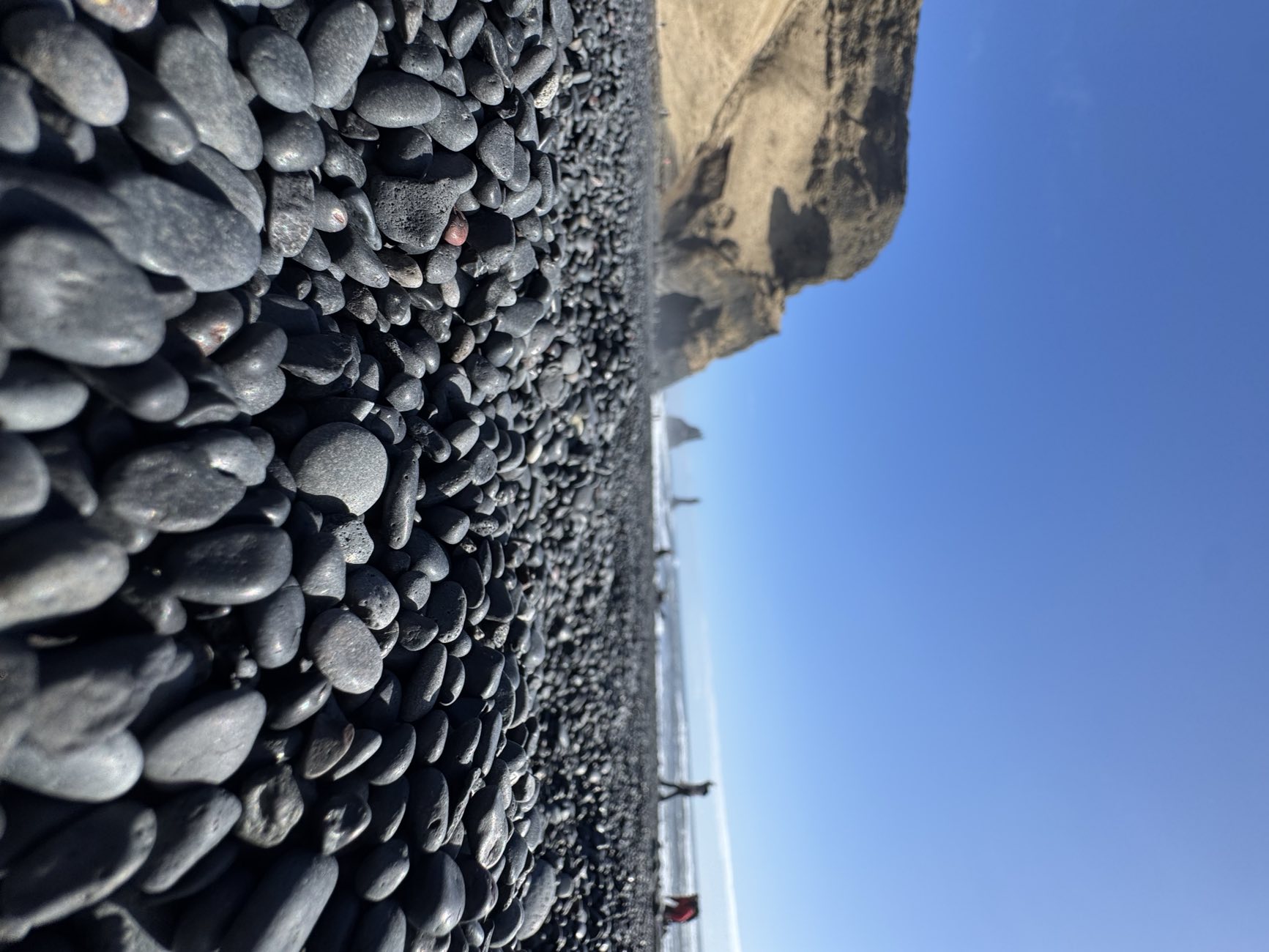
Black sand is a strange thing to photograph. It swallows light instead of bouncing it back, so your camera's meter panics and tries to make the whole frame grey. The first time I handed a visitor my camera at Reynisfjara, they fired off ten shots and every one came back a muddy brown. The beach is not brown. Learning to shoot it is mostly learning to argue with the meter.
Here is what I have worked out over a lot of cold mornings on this shore.
What light will you actually get at Reynisfjara?
Aim for the edges of the day: summer's midnight sun and long golden hours flatter black sand, while harsh midday light makes it look lifeless.
Iceland's summer is a gift and a problem for photographers. In June the sun barely sets, which means the golden light stretches for hours instead of minutes, and the "midnight sun" gives you a low, warm glow around the small hours when almost nobody else is on the beach. The trade-off is that harsh flat light in the middle of a bright day makes black sand look lifeless. Aim for the edges of the day.
Overcast is not the enemy here that people assume. A grey sky acts like a giant softbox, and the basalt columns and wet pebbles hold detail beautifully under it. Some of my favourite frames from this beach were shot under cloud that a holidaymaker would have called a ruined day.
Which compositions work best here?
The basalt columns for geometry, the Reynisdrangar stacks as a distant anchor, and the wet sand as a black mirror for the sky.
Three things at Reynisfjara reward you again and again. The Gardar basalt columns give you geometry, all those hexagons stacking up like a pipe organ, and they beg for a low angle looking up. The Reynisdrangar sea stacks offshore give you a distant anchor point, best with a longer lens that compresses them against the surf. And the sand itself gives you foreground: wet, it turns to a black mirror that catches the sky, and the receding surf leaves lines that pull the eye into the frame.
The trick with the mirror effect is to shoot low and shoot fast, in that narrow moment after a wave pulls back and before the sheen dries. Which brings me to the part that matters more than any of this.
How do you stay safe while shooting?
Never put your back to the ocean and keep yourself and the tripod well above the highest wet line, because photographers are the classic sneaker-wave victims.
Reynisfjara's waves kill people. Not often, but it has happened, because every so often a sneaker wave runs up the beach two or three times farther than the ones before it, fast and near silent, with an undertow that drags you into freezing water. Photographers are the classic victims: eye to the viewfinder, back to the sea, chasing that low reflected shot in the wet sand exactly where the water reaches.
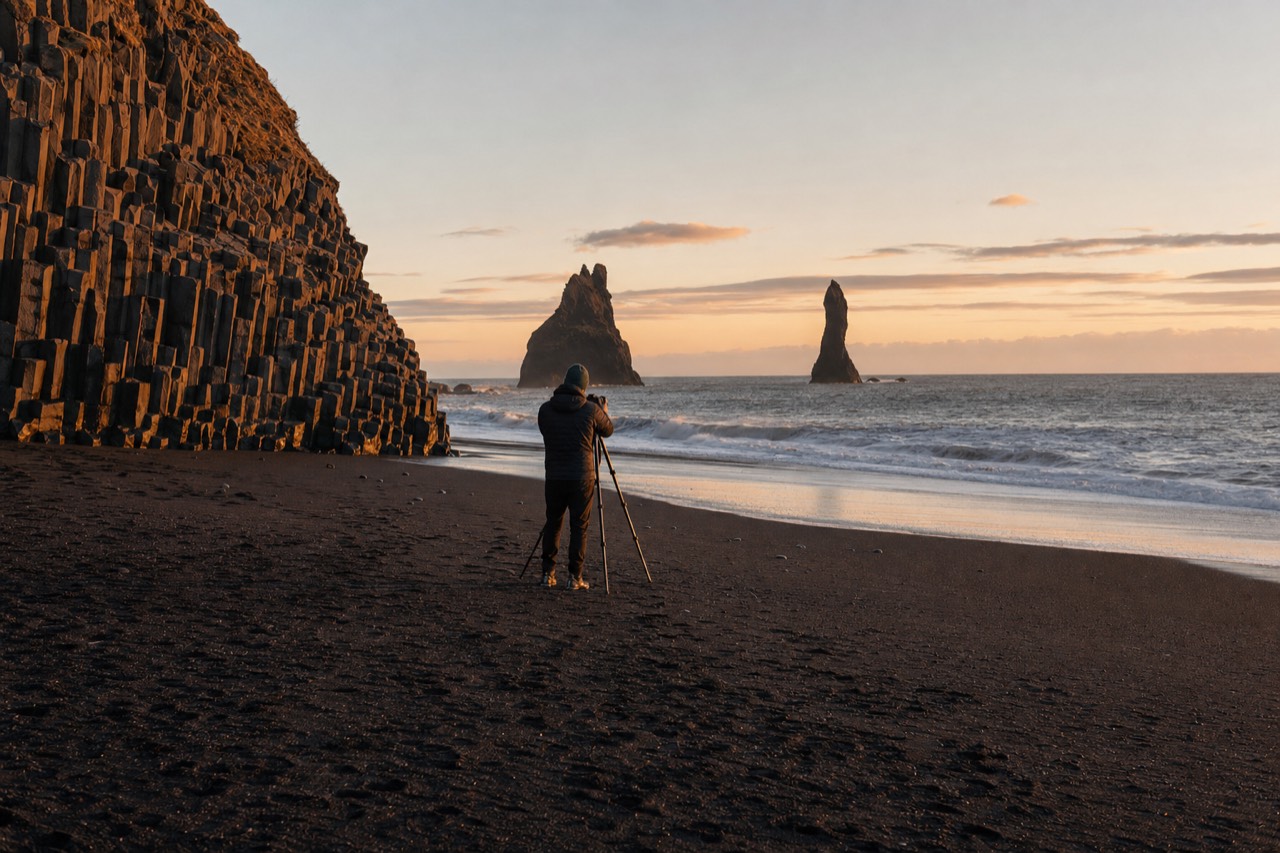
My rules are simple and I do not bend them. Never put your back to the ocean. Keep your tripod and yourself well up the beach, above the highest wet line you can see, and treat that line as generous, not tight. No shot is worth standing in the run-up zone. If you want the reflection, get it with a longer lens from higher up the slope.
If you would rather not add a long self-drive to your shooting day, the guided [South Coast day trip](https://www.getyourguide.com/reykjavik-l30/southern-iceland-tour-t67018/?partner_id=MME1WGW&utm_medium=online_publisher) from Reykjavik drops you at Reynisfjara with the driving and the clock handled, and a guide on hand who watches the water while you work. The window is around thirty minutes, so you go in knowing your shots.
What gear actually earns its place?
A wide lens, a longer lens, a tripod, an ND or polariser, cloths with a rain cover, and exposure compensation to fight the meter.
You do not need a bag full of glass. You need the right few things and a way to keep them dry.
| Item | Why it matters here | Rough setting to start |
|---|---|---|
| Wide lens | The columns from a low angle, big foreground sand | f/8 to f/11 for depth |
| Longer lens | Compress the sea stacks against the surf | f/5.6, faster shutter |
| Tripod | Low-light midnight-sun frames, smooth surf | Keep it up the beach |
| ND / polariser | Slow the water to silk, cut wet-rock glare | Vary with the light |
| Lens cloth + rain cover | Salt spray coats everything fast | Bring two cloths |
| Exposure comp | Stop the meter greying out the black sand | Dial up, watch highlights |
When are the best times to shoot, roughly?
The hours around midnight in June and early July give low warm light and an almost empty beach; failing that, early morning beats midday every time.
In June and early July, the hours around midnight give you low warm light and an almost empty beach, which is the dream if your schedule allows it. The other frame worth chasing, the northern lights arcing over the Reynisdrangar stacks, is a winter-night proposition entirely, and since the day trip runs in daylight you would reach the coast after dark on a separate aurora evening tour from Reykjavik: see the tour here. Failing that, early morning beats midday every time. Whatever the hour, the honest headline is the same: light and safety both live at the edges of the beach and the edges of the day. Respect the water, dial your exposure up off the black sand, and Reynisfjara turns from a brown mess into one of the most photogenic coastlines you will ever stand on.